
The Complete Guide
to Living on the
Hudson Waterfront
Weehawken, Hoboken, Jersey City, Edgewater, and Fort Lee
What it actually costs, how the commute works, and what buyers should know before choosing
People think the skyline is the story. It's not. The story is which town you pick, what it costs, and what the view really buys you. This guide walks through the whole Hudson waterfront, the honest way.

Table of Contents
The Waterfront
at a Glance
The Hudson waterfront corridor from Weehawken up to Fort Lee is one of the most desirable stretches of real estate in New Jersey. The skyline, the commute, the walkable waterfront: it sells itself. But the five towns along this corridor are not interchangeable. Here is the honest picture before you start looking.
Ferry from Port Imperial in Weehawken takes about 8 minutes. PATH from Hoboken takes 13-16 minutes. This is faster than most of Brooklyn and Queens.
Wide range depending on town, view, and property type. Jersey City and Edgewater offer more affordable entry points while Weehawken and Hoboken command the highest premiums.
Virtually all waterfront properties sit in FEMA-designated flood zones. Hoboken is the most affected, with about 75-79% of the city in a flood zone. Flood insurance is required and can add $2,000 to $5,000 per year.
Condos, co-ops, and high-rise towers dominate the waterfront. Single-family homes are rare and come at a significant premium. HOA fees are the norm and vary widely by building.
Hoboken is the worst, with parking spots costing as much as a car payment. Weehawken is better but still tight. Fort Lee and Edgewater are easier, especially with dedicated parking in condo buildings.
From the packed streets of Hoboken to the quiet residential blocks of Weehawken and the suburban feel of Fort Lee, every personality is covered along this corridor.
The honest truth about the waterfront premium
You are paying a premium for the view and the commute. That premium is real and it is significant compared to inland Passaic County prices. But the value is also real: no other place in New Jersey gives you a skyline view, an 8-minute commute to Manhattan, and a walkable waterfront in the same package. The question is not whether it is worth it. The question is whether it fits your budget and your life.
Town by Town
The skyline is the same from every town. The lifestyle is not. Here is an honest breakdown of each town's personality, commute, price range, and who it fits best.
Weehawken
The Quiet One
Residential, family-friendly, calm streets. Weehawken is the closest thing the Hudson waterfront has to a suburb. Tucked between the Palisades cliffs and the river, it offers some of the most stunning, unobstructed views of the Manhattan skyline from Boulevard East and Hamilton Park. The Port Imperial ferry terminal gets you to Midtown in about 8 minutes, and the Lincoln Tunnel portal is right here. The town has largely avoided the high-rise rush that reshaped its neighbors, preserving a quieter, more residential feel. Historic landmarks include the Weehawken Dueling Grounds where the Burr-Hamilton duel took place, the historic Water Tower resembling Florence's Palazzo Vecchio, and the long waterfront walkway stretching along the Hudson.
NY Waterway ferry from Port Imperial to Midtown: 8-10 min. Lincoln Tunnel to NYC: ~15 min by car. NJ Transit buses to Port Authority.
Hoboken
The Lively One
Restaurants, nightlife, brownstones, and young professionals define this mile-square city. Hoboken is the birthplace of Frank Sinatra and organized baseball, with Elysian Fields hosting the first modern baseball game in 1846. Today it is one of the most walkable cities in New Jersey, with a vibrant bar and dining scene, the famous Carlo's Bakery from Cake Boss, and Stevens Institute of Technology perched on Castle Point. The Hoboken Terminal is a major transportation hub with PATH, NJ Transit, buses, and the NY Waterway ferry all converging here. Brownstone-lined streets, Washington Street shopping, and the Hudson River Waterfront Walkway along Sinatra Drive make it a true urban community with small-town character.
PATH train from Hoboken Terminal to 33rd St: 13-16 min. NY Waterway ferry to Midtown: ~10 min. NJ Transit trains, buses, light rail.
Jersey City
The Big One
The second-largest city in New Jersey, Jersey City offers a wider range of prices, neighborhoods, and lifestyles than any other waterfront town. Downtown and the waterfront district feature gleaming high-rise towers housing major financial institutions, earning the nickname Wall Street West. But the city has many distinct faces: the historic brownstones of Paulus Hook, the arts-focused Powerhouse Arts District, the family-friendly Heights, and the sprawling Liberty State Park with its views of the Statue of Liberty and Ellis Island. Over 40 languages are spoken here, making it one of the most diverse cities in America. Multiple PATH stations serve different neighborhoods, giving commuters more flexibility than any other Hudson waterfront town.
PATH from Newport Station to 33rd St: ~15 min. From Grove Street: ~20 min. From Journal Square: ~23 min. NY Waterway ferry, light rail, buses.
Edgewater
The Close One
Perched right on the river north of Weehawken, Edgewater is a small Bergen County borough with a big personality. Mostly newer condo buildings and townhomes line River Road, offering direct Manhattan views from private balconies and floor-to-ceiling windows. The borough is known for its significant Japanese and Korean community, anchored by the Mitsuwa Marketplace, a Japanese food hall and grocery that draws visitors from across the region. SoJo Spa Club offers a Korean-inspired spa experience with skyline views. The Hudson River Waterfront Walkway runs through town, and the wild Quaker parrots that roost here have become a local curiosity. Edgewater feels more relaxed than the Hudson County towns, with easier parking and a suburban-meets-waterfront energy.
NJ Transit bus routes to Port Authority: 30-45 min. Car via Route 5 and Route 3 to Lincoln Tunnel: ~20-30 min. Nearby ferry at Port Imperial.
Fort Lee
The Overlook One
Fort Lee sits atop the Palisades above the river, offering sweeping skyline views from a completely different angle. The borough is the New Jersey terminus of the George Washington Bridge, one of the busiest bridges in the world, and it was the birthplace of the American film industry before Hollywood existed. Today it is best known for its vibrant Korean community, which anchors one of the largest Koreatowns outside of Korea along Main Street, packed with restaurants, cafes, bakeries, and karaoke bars. Fort Lee Historic Park preserves Revolutionary War fortifications with panoramic views. The housing stock ranges from high-rise condos with river views to garden apartments and single-family homes on quieter streets, giving buyers more space options than the Hudson County towns.
NJ Transit buses (routes 156, 158, 159) to Port Authority: 25-45 min. Car via GWB to Manhattan: ~15-20 min without traffic.
The Commute
Breakdown
The commute is the real superpower of the Hudson waterfront. No other part of New Jersey gets you into Manhattan this fast. Here is how each option works.
NY Waterway Ferry
The ferry is the fastest way across the river. From Port Imperial in Weehawken, the crossing to Midtown (W. 39th St.) takes about 8 minutes. There are additional terminals in Hoboken, Jersey City (Paulus Hook, Liberty Harbor), and Edgewater Landing. The ride itself is smooth, and the skyline views from the water are spectacular. The tradeoff is cost: a single ride is more expensive than the PATH, and monthly passes add up. If your office is on the west side of Midtown or near the ferry terminals, the door-to-door time is hard to beat.
Pro tip: The ferry is the premium option. If your employer offers commuter benefits or a ferry subsidy, it makes the decision easy. If you are paying out of pocket, compare the monthly cost against a PATH pass and factor in whether your office is walking distance from the ferry terminal or requires a transfer.
PATH Train
The PATH is the workhorse of the waterfront commute. From Hoboken Terminal to 33rd Street in Midtown takes about 13-16 minutes. From Jersey City, times vary by station: Newport Station to 33rd Street takes about 15 minutes, Grove Street to 33rd Street takes about 20 minutes, and Journal Square to 33rd Street takes about 23 minutes. The PATH runs 24 hours a day, which is a major advantage for anyone who works late or needs weekend access. Fares are significantly cheaper than the ferry. The tradeoff is that the trains can get crowded during peak hours, and there are occasional service disruptions.
NJ Transit & Express Buses
From Fort Lee and Edgewater, NJ Transit express buses are the primary transit option. Routes 156, 158, and 159 run from Fort Lee to the Port Authority Bus Terminal on 42nd Street, with trip times ranging from 25 to 45 minutes depending on the route and traffic. Edgewater connects via River Road routes and nearby bus terminals. The bus is a solid option if your office is near the Port Authority, but traffic on the George Washington Bridge and the approach roads can add significant time during peak hours. For Edgewater and Fort Lee residents, the bus is the most practical transit option unless you drive to the ferry.
Driving
Driving into Manhattan from the waterfront is fast when traffic cooperates and slow when it does not. Weehawken is home to the Lincoln Tunnel portal, so a drive to Midtown can take as little as 15 minutes off-peak. Fort Lee sits at the New Jersey end of the George Washington Bridge, with a similar quick trip to Upper Manhattan or the West Side when traffic is light. During rush hour, both crossings back up significantly. Toll costs add up: both the Lincoln Tunnel and GWB have tolls over $15 for round trips. Parking in Manhattan is expensive and hard to find. Most waterfront residents use transit for the daily commute and save the car for weekends and errands.
How the ferry compares to the PATH
Here is the honest comparison. The ferry is faster, more scenic, and more comfortable, but it costs more per trip and runs on a more limited schedule. The PATH is cheaper, runs 24/7, and connects to more subway lines, but it is more crowded and less pleasant during peak hours. If your office is on the west side of Midtown near the ferry terminal, the ferry wins on door-to-door time. If you need to get to the east side or downtown, the PATH is probably better. Many residents use both depending on the day. The best approach is to test both routes from your specific home and office before deciding.
What Buyers
Should Know
The glossy brochures and Instagram photos leave out the real considerations. Here is what every buyer needs to know before shopping the waterfront.
Flood Zones and Flood Insurance
This is the biggest hidden cost for waterfront buyers. Vast stretches of the Hudson waterfront sit in FEMA-designated flood zones. Hoboken is the most affected, with roughly 75-79% of the city in a flood zone, including its entire Hudson River coastline designated as Zone VE (coastal high hazard). Weehawken, Jersey City, and Edgewater all have substantial areas in Zone A/AE. The post-Sandy FEMA maps redrew flood boundaries, and the Rebuild by Design Hudson River program is constructing flood protection infrastructure throughout the area. But for now, flood insurance is required for any property with a federally backed mortgage in a flood zone. Annual premiums typically run $2,000 to $5,000, and sometimes more for high-value properties or buildings with ground-floor units. Check the flood maps before you make an offer, not after.
Parking Scarcity and Cost
If you own a car, parking is one of the biggest practical challenges of waterfront living. Hoboken is the most extreme: a deeded parking spot can cost $200 to $400 per month in a garage, and some spots sell for as much as a used car. Street parking is competitive, with permit restrictions and alternate-side rules. Weehawken is better but far from easy, especially near the denser blocks around Port Imperial. Jersey City varies by neighborhood: the waterfront towers have garage parking (at a cost), while the brownstone neighborhoods rely on street permits. Fort Lee and Edgewater are easier, with more surface lots and dedicated parking in most condo buildings. If you need two cars, factor parking costs into your budget from the start.
Property Taxes vs. Inland Counties
Property taxes on the waterfront are generally comparable to other New Jersey urban areas, but the comparison to inland Passaic County is worth making. Hudson County towns like Hoboken and Jersey City have tax rates that are competitive with or slightly below Passaic County on a percentage basis, but the higher assessed values mean the dollar amount is higher. A $700,000 condo in Jersey City will have a tax bill in the range of what a $500,000 single-family home in Clifton carries. Fort Lee is in Bergen County, which tends to have higher tax rates than Passaic County. The tradeoff is that waterfront properties have historically appreciated faster, so the tax burden is offset by stronger equity growth.
HOA Fees and Condo Board Rules
Almost every waterfront property is a condo or co-op, which means HOA fees are part of the deal. Monthly fees in the high-rise towers can range from $400 to $1,200 per month depending on the building's amenities, age, and services. Doorman buildings, pools, gyms, and roof decks all add to the monthly cost. Older buildings may have lower fees but face the risk of special assessments for major repairs like facade work, elevator replacement, or new boilers. Condo board rules vary: some buildings restrict rentals, others limit pets or require board approval for buyers. Always read the building's financials and minutes before making an offer. A building with a healthy reserve fund and no pending assessments is worth paying a little more for.
The Premium for a View Floor
The premium for floors with actual skyline views is substantial. In the same building, a unit on the 15th floor facing the river can cost 20-40% more than a similar unit on the 3rd floor facing the street. That premium is not always rational, but it is real. If the view matters to you, budget for it. If your priority is getting into the town itself and the commute, consider a lower-floor unit or a non-view side of the building. You will still have access to the same waterfront, the same parks, the same commute. The sunsets from the street level are free.
Day to Day:
The Skyline as Routine
The most surprising thing about living on the Hudson waterfront is how normal the view becomes. Not because it stops being beautiful. Because it becomes part of your life in a way that a one-time visit never could.
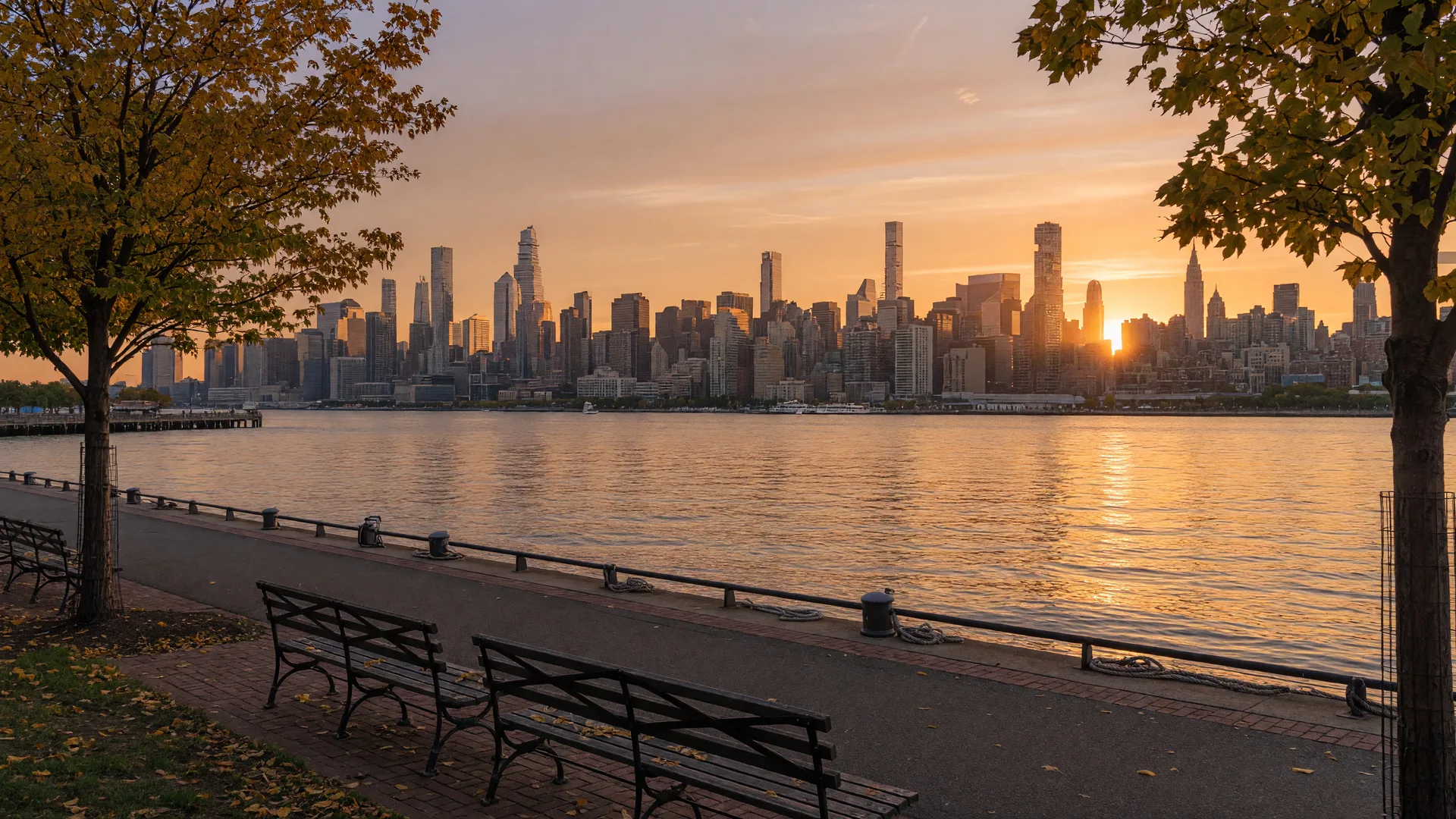
The walkable promenades along the river are the centerpiece of daily life in every waterfront town. In Weehawken, the waterfront walkway stretches for over a mile, with benches facing the skyline and people walking dogs, pushing strollers, or just standing still watching the sun go down. In Hoboken, the Hudson River Waterfront Walkway along Sinatra Drive is the town's unofficial living room, packed with runners, cyclists, and couples at sunset. Jersey City's Liberty State Park offers a completely different perspective, with the Statue of Liberty and Ellis Island in the foreground and Lower Manhattan behind them.
Residents treat the skyline as routine. That is not indifference. It is the whole point. You walk down to the water after work, coffee in hand, and the whole city is lit up across the river. It is Tuesday. It is just another Tuesday. That is exactly why it is special.
The waterfront is not just a backdrop, it is a lifestyle. The parks along the river host farmers markets, outdoor concerts, and community events. The ferry terminals have coffee shops and small markets. The waterfront walkways connect parks, playgrounds, and picnic areas. You do not need a plan to enjoy it. You just need to live here.
There is a moment every new waterfront resident experiences. It happens about two weeks after moving in. You are walking home from the ferry or stepping out for a run or just looking out the window, and you realize the view is not a special occasion. It is the backdrop of your normal life. That is when you know you made the right choice.
Morning coffee, skyline view
Start your day with the Manhattan skyline across the river from your window, your balcony, or the waterfront promenade steps from your door.
Sunset walks on the promenade
The sunset over the Manhattan skyline is free, it is every night, and it is a five-minute walk from your front door. That never gets old.
The commute that does not feel like one
An 8-minute ferry ride with the skyline getting closer. That is not a commute. That is the best part of your morning.
The view that becomes your normal
After a few weeks, the skyline becomes the backdrop of your everyday life. The special never fades, but it becomes familiar. That is the whole point.
Is the Waterfront
Right for You?
Yes, if you...
Commute to the city regularly
If you work in Manhattan, the waterfront commute is an upgrade. An 8-minute ferry or a 15-minute PATH ride beats almost any transit option from Brooklyn, Queens, or most of New Jersey.
Want the view as your everyday
The skyline is not a one-time event. It is your morning coffee backdrop, your evening walk companion, your dinner party conversation piece. If that sounds like the life you want, the waterfront delivers.
Are comfortable with condo life and HOA fees
The waterfront is primarily a condo and co-op market. If you are ready for building amenities, shared spaces, monthly HOA fees, and board rules, you will find plenty of options. If you need a single-family house with a yard, you will struggle.
Are ready to buy in a competitive market
Waterfront properties move fast. Well-priced listings in Weehawken and Hoboken often go under contract within two weeks. If you find the right place, be ready to move.
Maybe not, if you...
Need a big suburban lot
If you want acreage, a big yard, or a detached single-family home with a driveway, the waterfront is not the right fit. Look inland to Passaic or Bergen County towns for that.
Are on a tight budget
The waterfront commands a premium. Entry-level prices start in the mid-$600,000s in Jersey City and Edgewater and climb well into the millions in Weehawken and Hoboken. If your budget is under $600K, the inland towns offer much more house for the money.
Hate parking hassles
If parking is a dealbreaker for you, Hoboken and Jersey City will frustrate you. Even Weehawken and Edgewater have parking challenges. Fort Lee is the easiest option of the five, but none of the waterfront towns offer the parking convenience of a suburban driveway.
Want Passaic County prices
If your frame of reference is Clifton, Woodland Park, or Totowa prices, the waterfront will be a shock. Same state, very different price points. The premium is real, but so is the value you get for it.
The bottom line
The Hudson waterfront offers one of the best combinations of commute, views, and lifestyle in New Jersey. But it is not for everyone. The honest version is this: if you commute to Manhattan, can handle condo living, and understand the premium you are paying for the view, the waterfront is a fantastic place to live. If you need space, parking, and Passaic County prices, inland towns will serve you better. Knowing the difference is the whole point of this guide.
Ready to Find
Your View?
Whether it is Weehawken, Hoboken, or any town on the water, I will give you the honest breakdown. No sugarcoating, no pressure.
Licensed Real Estate Agent in the State of New Jersey · License #1222734 · Affiliated with Realty One Group Legend, 600 Getty Avenue, Clifton, NJ 07011 · Brokerage: (973) 772-0660 · Home price ranges and market data are estimates based on publicly available sources including Zillow, Redfin, and Movoto as of August 2026 and may vary by property condition, location, view floor, and current market conditions. Flood zone information based on FEMA flood insurance rate maps for Hudson County. Commute times are approximate and vary by departure time, route, and traffic. Equal Housing Opportunity.