
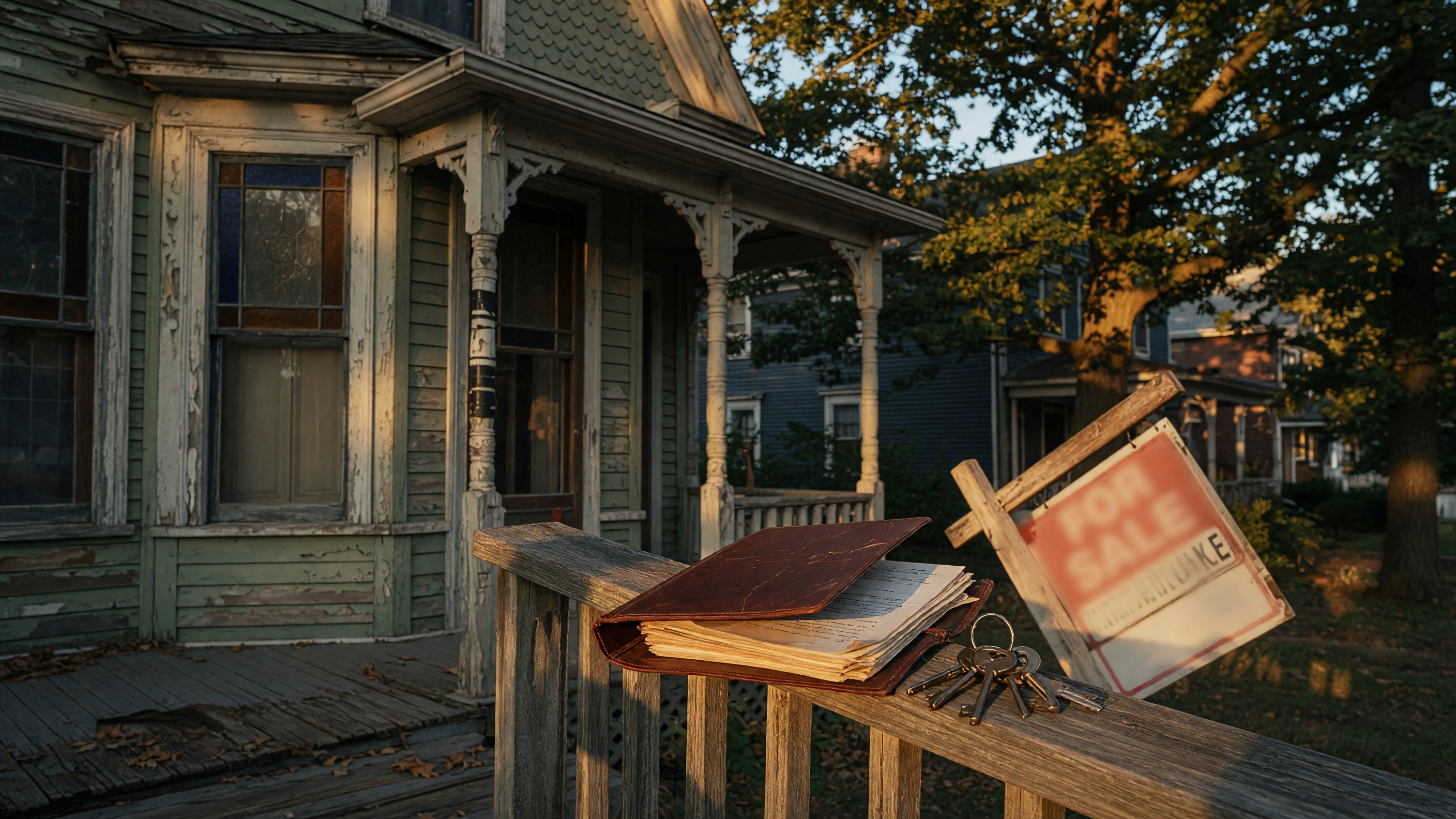
Tax Implications of Selling Inherited Property in North Jersey

Every week, I get a call from someone who just lost a parent or a loved one, and they have a house they need to sell. They are grieving, they are overwhelmed, and the last thing on their mind is taxes. But taxes are one of the first things that will affect how much money they actually walk away with. New Jersey has some of the most confusing tax rules in the country when it comes to inherited property. Most people have never dealt with inheritance tax, estate tax, or capital gains before, and they do not know where to start. I am going to break it down in plain English so you know exactly what you are dealing with before you list that property.
New Jersey Estate Tax: It No Longer Exists
Let me start with the good news. New Jersey used to have a state estate tax that kicked in on estates valued above $675,000. That tax was eliminated on January 1, 2018. If your loved one passed away in 2018 or later, there is no New Jersey estate tax to worry about. That is one less thing on your plate.
The federal estate tax still exists, but it only applies to estates valued above approximately $13.99 million in 2025. For the vast majority of families in Passaic and Bergen County, the federal threshold is so high that it will not apply. If your parent owned a home worth $500,000 and had a modest savings account, you are almost certainly under the federal limit. Do not lose sleep over the federal estate tax unless the estate is worth more than $14 million.
New Jersey Inheritance Tax: This One Still Applies
Here is where it gets tricky. New Jersey is one of only six states that still charges an inheritance tax. This tax is based on your relationship to the person who passed away, not the value of the estate. That distinction matters, and it catches a lot of families off guard.
Class A beneficiaries (no tax): If you are the surviving spouse, child, stepchild, grandchild, parent, or grandparent of the deceased, you are in Class A. You owe zero inheritance tax on the inherited property, regardless of its value. Most of my probate clients fall into this category, and this is the most common scenario.
Class C beneficiaries (tax applies after $25,000): If you are a sibling, in-law, stepsibling, or child-in-law of the deceased, you are in Class C. You get a $25,000 exemption, and then the tax kicks in. The rate is 11% on amounts from $25,001 to $1.1 million, scaling up to 16% on amounts above $1.7 million. This is the category that surprises people the most. I have seen brothers and sisters inherit their parents' home together and not realize they owe inheritance tax on their share.
Class D beneficiaries (tax on almost everything): If you are a cousin, friend, or anyone not in Class A or C, you are in Class D. There is no exemption, and the rate starts at 15% on amounts above $500. If you are inheriting property from someone who was not a close family member, this tax hits hard.
One critical detail: the inheritance tax return is due within eight months of the date of death. If you miss that deadline, penalties and interest accumulate fast. I always tell heirs to get an estate attorney involved immediately so the clock does not become a problem.
The Step-Up in Basis: Your Biggest Tax Advantage
This is the tax benefit that most heirs do not know about, and it is the one that saves families the most money. When you inherit a property, the IRS gives you a step-up in basis. That means your cost basis for the property is reset to the fair market value on the date your loved one passed away. Not what they paid for it. What it was worth when they died.
Here is why that matters. Say your parents bought their home in Paterson in 1985 for $85,000. Today, it is worth $475,000. If they had sold it themselves, they would owe capital gains tax on $390,000 of profit. But because you inherited it, your cost basis is stepped up to $475,000. If you turn around and sell it for $475,000, your taxable gain is zero. You pay no federal capital gains tax. None.
Even if you hold the property for a few months and sell it for $490,000, your gain is only $15,000, not $405,000. The step-up in basis eliminates decades of appreciation from your tax liability. This is one of the most powerful wealth-transfer tools in the tax code, and it is the main reason I tell heirs not to panic about capital gains when they first inherit a property.
New Jersey Treats Capital Gains as Ordinary Income
Here is the part that trips people up. The federal government treats long-term capital gains at preferential rates of 0%, 15%, or 20% depending on your income. New Jersey does not. New Jersey taxes all capital gains as ordinary income, which means they are subject to the state's progressive income tax rates that go as high as 10.75% for the highest earners.
So while the step-up in basis dramatically reduces or eliminates your federal capital gains exposure, you still need to think about what the property sells for relative to the stepped-up basis when calculating your New Jersey tax liability. In most cases, when a property is sold relatively quickly after inheritance, the gain is small enough that the NJ tax impact is minimal. But if you hold the property for several years and it appreciates, the NJ tax on that gain is real.
The Tax Waiver: You Cannot Close Without It
In New Jersey, you cannot transfer real estate after someone passes away without obtaining a tax waiver from the state. This is typically done by filing Form L-9 with the NJ Division of Taxation. The waiver certifies that all inheritance taxes have been paid or that no tax is owed. Every title company and closing attorney in Passaic and Bergen County will require this waiver before they will let you close on the sale.
If no inheritance tax is owed (because all heirs are Class A), the waiver process is straightforward but still takes time. If inheritance tax is owed, the waiver cannot be issued until the tax is paid. This is one of the main reasons probate sales take longer than standard transactions. The paperwork has to be done right, and shortcuts do not work.
What This Looks Like With Real Numbers
Let me walk through a typical scenario. A family in Clifton inherits their parents' home, worth approximately $600,000. The parents bought it in 1990 for $155,000. Three adult children inherit it equally, and all three are Class A beneficiaries (direct children).
Inheritance tax: Zero. Class A beneficiaries pay no NJ inheritance tax.
Federal capital gains: The stepped-up basis is $600,000. If the heirs sell for $600,000, the taxable gain is zero. If they sell for $620,000 after a few months of cleaning and minor repairs, the gain is $20,000, split three ways at $6,667 each. At the 15% federal rate, that is roughly $1,000 per heir.
New Jersey income tax: That same $20,000 gain is taxed as ordinary income in New Jersey. Depending on the heir's total income, the NJ rate could be anywhere from 1.4% to 10.75%. For most middle-income families, the effective rate is somewhere in the 5% to 8% range, which means an additional $1,000 to $1,600 per heir.
Realty transfer fee: New Jersey charges a realty transfer fee when property changes hands. On a $620,000 sale, this fee is approximately $4,200. This is paid at closing and is standard for any real estate transaction in the state.
The bottom line for this family: they sell a $600,000 home with a stepped-up basis, owe zero inheritance tax, and their total tax exposure is a few thousand dollars per heir. Compare that to the $445,000 in capital gains they would have faced if the step-up did not exist. That is the power of understanding your tax position before you act.
The Mistakes I See Heirs Make
After 15 years of working probate sales in North Jersey, here are the tax-related mistakes I see most often.
Selling too far below market value. Some heirs are so eager to get rid of the property that they accept the first offer without getting a proper valuation. If you sell a $600,000 home for $520,000 because you want a quick sale, you just left $80,000 on the table. The step-up in basis means you are not going to owe significant capital gains anyway, so there is no tax reason to rush at a discount.
Ignoring the inheritance tax classification. I have seen situations where siblings inherit a home and one sibling is Class A (a child) while another beneficiary is Class C (a sibling-in-law or stepsibling). The tax implications are completely different for each person. You need to know who falls into which class before you divide anything.
Not getting the date-of-death appraisal. You need a professional appraisal or a documented comparable market analysis establishing the property's fair market value on the date of death. This is your stepped-up basis. Without it, the IRS can challenge your numbers, and you could end up paying tax on gains that do not actually exist.
Waiting too long to file the tax waiver. The tax waiver process takes time, and delays push back your closing date. Every week you wait is another week of carrying costs on a vacant property. Get the estate attorney moving on the waiver as soon as possible.
What I Recommend Every Heir Do First
Before you make any decisions about the property, take these three steps. First, consult with an estate attorney who handles NJ probate. You need to understand your tax classification, the inheritance tax implications, and the waiver requirements. Second, get a professional market valuation of the property so you know what it is worth in today's market. Third, talk to a real estate agent who specializes in probate transactions in Passaic or Bergen County. I am a Probate Certified Specialist, and I work with families on this every single week. I coordinate with the estate attorney, the title company, and the tax professionals to make sure nothing falls through the cracks.
The goal is not just to sell the house. The goal is to sell it in a way that protects the estate, minimizes your tax exposure, and puts the maximum amount of money in the heirs' pockets. That starts with understanding the tax reality, not guessing at it.
Need Clarity on the Tax Side of an Inherited Property?
I will connect you with the right professionals, walk you through your options, and make sure you understand exactly what you owe and what you do not. No charge for the first conversation. Just honest answers so you can make smart decisions from day one.
Schedule a Free Probate Consultation North Jersey's AI-Certified Realtor with 15+ years of experience. Specializing in probate sales, short sales, and distressed properties in Passaic and Bergen County.