North Jersey Investor Toolkit | 7 Multi-Family Wealth Strategies 2026

I have been buying and selling multi-family properties in North Jersey for 15 years. I have worked with first-time investors who turned a single duplex into a seven-figure portfolio. I have also watched people lose money because they skipped the underwriting and bought on emotion. Real estate investing in Passaic and Bergen County is not a get-rich-quick game. It is a wealth-building discipline that works when you have the right tools, the right market knowledge, and the patience to execute. The numbers in North Jersey are compelling right now. Passaic County multi-family cap rates run between 5% and 7%. Bergen County sits in the mid-5% range with stronger tenant demand and appreciating property values. Average apartment rents in Clifton top $2,200 per month for a one-bedroom. But those numbers mean nothing if you do not know what to do with them. Here are the seven strategies that actually work for building wealth through multi-family real estate in North Jersey in 2026.
Strategy One: Master the Multi-Family Underwriting Framework
Before you buy anything, you need to know how to analyze a deal. Most first-time investors in North Jersey skip this step. They see a two-family in Clifton listed for $650,000, hear the seller say it rents for $3,800 per month total, and assume it works. It probably does not. Here is the framework I use for every multi-family deal I evaluate.
Start with gross scheduled rent. That is the maximum rent the property would generate if every unit was occupied at market rate year round. For a two-family in Paterson with two units renting at $1,400 each, that is $33,600 per year. Subtract 8% for vacancy and collection loss, which is realistic for Passaic County. That brings you to $30,912. Subtract property taxes, which in Paterson run about $6,000 to $8,000 per year on a multi-family property. Subtract insurance at $1,500 to $2,500. Subtract maintenance at 10% of gross rent, which is $3,360. Subtract property management at 8% to 10% if you plan to hire someone. Subtract capital reserves at $150 per unit per month, which is $3,600 per year for a two-family. What you have left is your net operating income. On a Paterson two-family with $33,600 in gross rent, you end up with an NOI around $14,000 to $16,000 after all expenses. If the asking price is $400,000, that is a 3.5% to 4% cap rate, which is not strong enough.
The difference between a good deal and a bad deal comes down to whether you run these numbers before you make an offer. I recommend creating a standardized deal analysis spreadsheet that includes every expense category. Run every property through it before you submit an offer. If the numbers work on paper with conservative assumptions, the real world will usually work too. If they only work with aggressive assumptions, walk away.
Strategy Two: Target Passaic County for Cash Flow, Bergen County for Appreciation
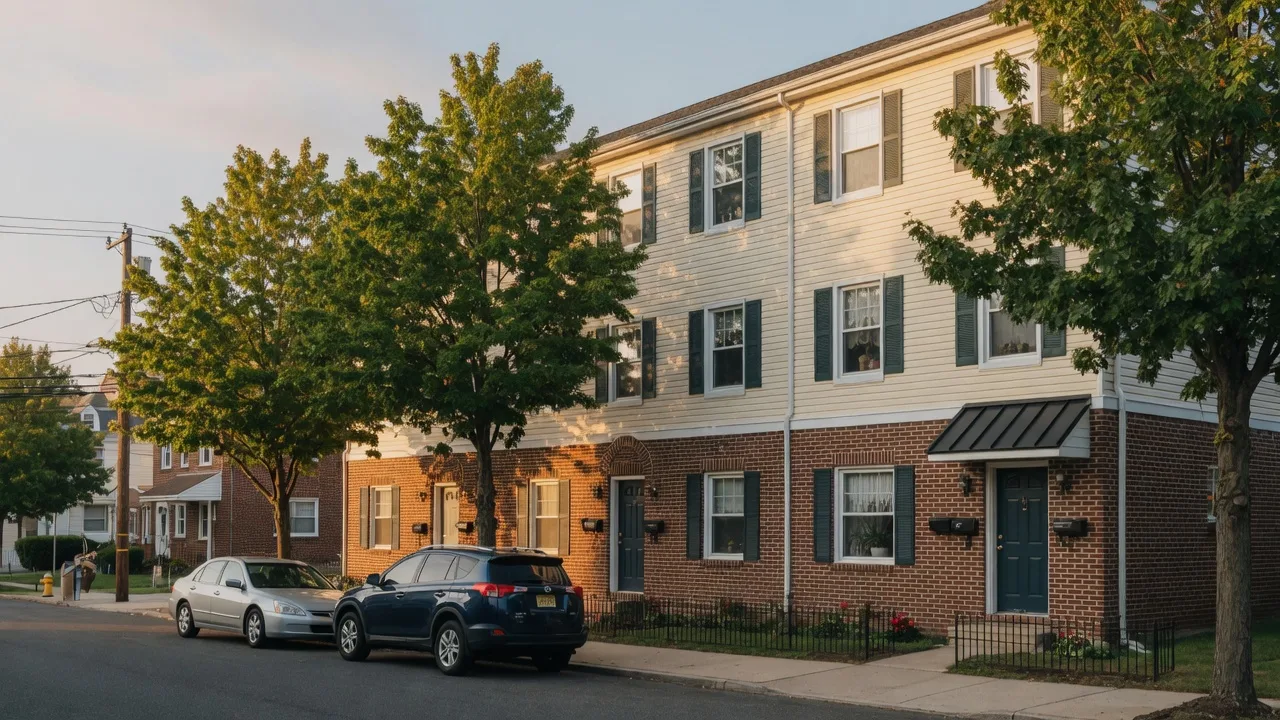
Each county serves a different investment strategy. In Passaic County, towns like Paterson and Passaic offer lower purchase prices and higher cap rates. A two-family in Paterson might cost $350,000 to $450,000 and generate cap rates of 6% to 7% when you buy right. The rental market is steady, driven by affordable housing demand, Section 8 vouchers, and proximity to Manhattan commuter routes. Cash flow is the primary return driver here.
In Bergen County, the math is different. Purchase prices are higher. A similar two-family in Garfield or Hackensack might cost $550,000 to $700,000. Cap rates compress to 4.5% to 5.5%. But Bergen County properties appreciate faster, driven by stronger job growth, better schools, and infrastructure investment like the Hudson-Bergen Light Rail expansion. The return in Bergen County comes more from appreciation and equity buildup than from monthly cash flow. An investor who buys in Paterson for cash flow and in Garfield for appreciation builds a balanced portfolio. Most investors pick one strategy or the other. The smart ones use both.
Strategy Three: Use the BRRRR Method in Undervalued Neighborhoods
The BRRRR strategy Buy, Rehab, Rent, Refinance, Repeat is alive and well in North Jersey, but it takes discipline to execute. The key metric is the spread between your all-in cost and the after-repair value. You need to buy a property below market, put in enough renovation to increase its value, and then refinance based on the new appraised value rather than what you paid for it. In Paterson and Passaic, the BRRRR works best on two-family and three-family properties that need cosmetic updates. A property that sells for $300,000 in rough condition might appraise for $450,000 after $75,000 in renovations. A cash-out refinance at 75% loan-to-value gives you $337,500. That pays off your original acquisition, covers the rehab, and leaves you with recovered capital to buy the next deal while the property itself cash flows on the new mortgage. The numbers work best when you keep the renovation focused on kitchens, bathrooms, flooring, paint, and curb appeal. Avoid structural work and major system replacements unless the price is low enough to absorb them. I have seen investors successfully use the BRRRR in Totowa and Woodland Park too, where older multi-family homes with deferred maintenance can be bought at a discount and repositioned for higher rents.
The risk in the BRRRR is overestimating the after-repair value. An appraiser will look at closed sales of similar renovated properties in the same neighborhood, not at your renovation budget. If the comps do not support your projected ARV, the refinance will not return your capital. Get a broker price opinion or appraisal before you commit to the rehab. The BRRRR is a powerful tool, but it only works when you buy right and renovate smart.
Strategy Four: Build a Section 8 Income Floor
Section 8 housing vouchers are one of the most underrated tools in the North Jersey investor's kit. The Housing Authority of Passaic County administers over 1,700 vouchers. The average Section 8 payment standard in Passaic County is around $1,000 to $1,200 per unit per month, paid directly by the government on the first of every month. That income is guaranteed. It does not depend on a tenant's job stability, credit score, or personal financial decisions. When you buy a multi-family property in Paterson, Clifton, or Passaic and position it for Section 8 tenants, you create a floor under your cash flow that the private rental market cannot match.
There are requirements you need to meet. The property must pass an HQS inspection before a Section 8 tenant can move in. That inspection covers basic health and safety standards: working smoke detectors, adequate heat and hot water, safe electrical systems, no lead paint hazards, and no pest infestations. Properties that already meet these standards or that need only minor repairs are the best candidates. The inspection is not a gut rehab. It is a baseline threshold that a well-maintained building passes easily.
The biggest advantage of Section 8 for a multi-family investor is tenant retention. Section 8 tenants stay longer than private-market tenants because they have limited housing options and their voucher is tied to the specific unit. When a Section 8 tenant leaves, the unit needs to pass inspection again, and the tenant faces the stress of finding a new landlord who accepts vouchers. Most Section 8 tenants do not move unless they have to. That stability reduces turnover costs, vacancy periods, and the stress of constantly finding new tenants. In a market where multi-family turnover can eat 8% to 10% of your gross rent every year, lower turnover is real money.
Strategy Five: Find Off-Market Deals Through Probate and Estate Connections
The best multi-family deals in North Jersey never hit the MLS. They are sold by families who inherited a property they do not want or by landlords who are ready to exit the business. These sellers are motivated to close quickly and will often accept a price below market value to avoid the hassle of listing, showings, and waiting. The way to find these deals is through relationships, not through search alerts. I work with probate and estate sellers every week in Passaic and Bergen County. When a family inherits a multi-family property and does not want to be landlords, they call me to help them sell. I also have relationships with estate attorneys and title companies who know about properties months before they come to market. If you are an investor looking for off-market multi-family deals in North Jersey, the fastest path is to connect with an agent who works in probate real estate every day.
Direct outreach still works, especially in neighborhoods where multi-family properties are concentrated. Drive the blocks in Paterson's Eastside, Clifton's Dutch Hill, and Totowa's older neighborhoods. Look for properties with overgrown yards, uncollected mail, or signs of vacancy. Cross-reference with county tax records to identify properties owned by estates or LLCs that may be inactive. A well-written letter to the executor or the out-of-state heir can open a conversation that leads to a deal. The investors who do the legwork consistently are the ones who find the off-market deals. The ones who wait for listings to show up on Zillow buy at retail prices.
Strategy Six: Property Management Is the Difference Between Profit and Loss
I have watched too many investors buy a multi-family property, struggle with tenants for six months, and sell at a loss because they did not plan for management. Running a rental property in North Jersey is not passive income. It is active work. Tenants call at 2 AM when the heat goes out in January. Evictions in New Jersey take time, and nonpayment evictions can stretch 90 days or more. A bad tenant can destroy your cash flow for six months while you wait for the court to process the case.
Professional property management in Passaic and Bergen County typically costs 8% to 10% of gross rent. That is $3,000 to $4,000 per year on a two-family generating $40,000 in rent. That fee is worth every penny if it means your property stays occupied, maintenance gets handled, and you do not have to deal with late-night tenant calls. Good property managers also handle Section 8 compliance, tenant screening, lease enforcement, and eviction proceedings. You cannot manage a growing portfolio without a management system. Either you build one yourself or you hire someone who already has one.
The other side of property management is tenant screening. Tenant quality is the single biggest variable in rental property performance. A bad tenant can cost you $10,000 to $15,000 in unpaid rent, legal fees, and repair costs over the course of a year. Screen for credit history, rental history, income verification, and criminal background. Require first month's rent plus a security deposit equal to one and a half months rent, which is the maximum allowed in New Jersey. And do not skip the lease. A written lease with clear terms for rent due dates, late fees, maintenance responsibilities, and lease violations is your only protection if things go wrong.
Strategy Seven: Build Your Portfolio One Deal at a Time With a Long-Term Mindset
The investors who succeed in North Jersey real estate are not the ones who try to buy ten properties in their first year. They are the ones who buy one good deal, prove the model, learn the process, and then repeat it. A single two-family in Clifton that you buy for $550,000, put $30,000 into renovations, and rent for $4,200 per month can generate $12,000 to $15,000 in annual cash flow after all expenses. That is not life-changing money on its own. But three properties doing the same thing is $36,000 to $45,000 per year. Six properties is $72,000 to $90,000. The math compounds, especially when you factor in rent increases (average 3% to 4% per year in North Jersey), mortgage paydown, and property appreciation (Passaic County home values are up about 13% year over year).
The most common mistake I see is buying too fast without enough reserve capital. Every rental property needs reserves. You need cash for repairs, vacancies, legal fees, and unexpected expenses. I tell every investor I work with to keep at least $10,000 per property in liquid reserves before buying the next one. Without reserves, one bad tenant or one major repair can force you into a cash flow crisis that wipes out years of gains. Patience is not a weakness in real estate investing. It is the single biggest competitive advantage you can have.
The Bottom Line for North Jersey Investors
Multi-family real estate in Passaic and Bergen County is one of the most reliable wealth-building tools available to investors in this market. The cap rates are competitive. The rental demand is driven by the same fundamentals that make North Jersey one of the most desirable regions in the country: proximity to New York City, strong job growth, excellent schools, and a diverse housing stock. But the market does not hand out profits. You have to earn them through disciplined underwriting, realistic projections, and patient execution. The investors who succeed in this market are the ones who do the math before they make the offer. The ones who fail are the ones who buy the deal and hope the numbers work out. Hope is not a strategy. Analysis is.
I have been analyzing multi-family properties in North Jersey for 15 years. I know the neighborhoods, the rent comps, the tax burdens, and the hidden costs that first-time investors miss. If you are looking at a deal and want someone to run the numbers with you honestly, no agenda, no sales pitch, I will do that. If you are looking for off-market opportunities, I can help with that too. The goal is not just to close. It is to help you win.
Ready to Build Your North Jersey Investment Portfolio?
I work with investors every day in Passaic and Bergen County, helping them find, analyze, and close multi-family deals that make financial sense. Schedule a free investment consultation and let us talk about your goals, your budget, and the opportunities that exist in this market right now.
North Jersey's AI-Certified Realtor with 15+ years of experience. Specializing in probate sales, short sales, and distressed properties in Passaic and Bergen County.