How to Buy Multi-Family Property in North Jersey | Investor Guide

If you are thinking about buying a multi-family property in North Jersey, you are probably looking at the numbers and thinking this could work. And you are right. Multi-family real estate in Passaic and Bergen County is one of the strongest wealth-building opportunities in the state. Duplexes, triplexes, and four-family properties in towns like Paterson, Clifton, Passaic, Garfield, and Haledon generate real rental income, build equity fast, and give you the kind of monthly cash flow that single-family rentals rarely match. But buying a multi-family property is not the same as buying a house to live in. The numbers are different. The risks are different. And the mistakes cost a lot more. After 15 years of working with investors across North Jersey, here is the honest breakdown of how to buy multi-family property the right way.
Why Multi-Family Works in Passaic and Bergen County
The fundamentals of the North Jersey rental market are strong and have been for years. Population density is high. Job access to Manhattan and the broader metro area is excellent via NJ Transit, Route 21, I-80, and the Garden State Parkway. Vacancy rates in Passaic County have stayed low because demand for affordable rental housing consistently outpaces supply. According to Redfin, the median home sale price in Passaic County sits around $612,000 to $640,000 as of mid-2026. In Clifton, the median sale price runs around $630,000. These numbers mean single-family homeownership is getting harder for a lot of working families. And when buying gets harder, renting gets more competitive. That is the environment where multi-family investors thrive.
Here is what makes the North Jersey multi-family market specifically attractive. The rent-to-price ratio in Paterson, Passaic, Garfield, and parts of Clifton is significantly better than what you find in Bergen County or the closer-in commuter towns. A two-family property in Paterson that costs $550,000 can generate $3,600 to $4,200 per month in combined rental income. A similar property in Paramus or Ridgewood might cost $900,000 and generate the same rent. The cash-on-cash return is dramatically different. This is where the real opportunity lives.
Know What You Are Buying: The Types of Multi-Family
Not all multi-family properties are the same, and the financing, management, and risk profile changes significantly depending on what you are looking at.
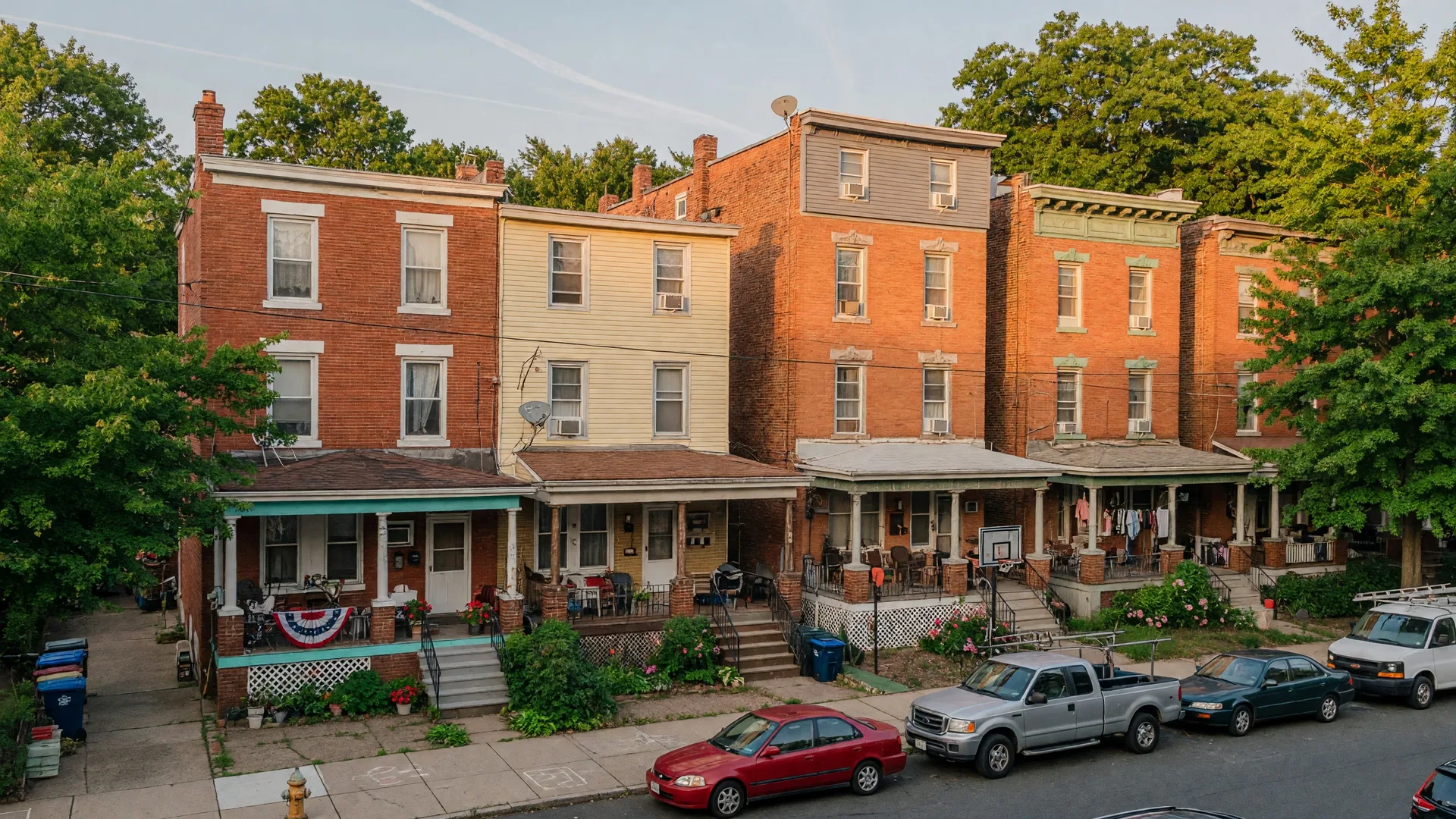
Duplex (two units). The most common entry point for new investors. You can live in one unit and rent the other, which qualifies you for owner-occupied financing with as little as 3.5% down on an FHA loan. Two-family homes are abundant in Paterson, Passaic, Clifton, and Garfield. This is the best starting point for someone who wants to learn the business with reduced risk.
Triplex (three units). Still qualifies for residential financing if you live in one unit, but three units means more income, more tenants, and more management complexity. Triplexes are less common than duplexes but show up regularly in Paterson and Passaic. The math works well here because you get the third unit's income without moving into commercial loan territory.
Four-family and larger. Properties with four or more units are considered commercial for financing purposes. You will need a commercial loan or a portfolio lender, which typically requires 20% to 25% down, higher interest rates, and stricter underwriting. The income potential is higher, but so is the barrier to entry. Most first-time investors in North Jersey should start with two to three units and scale from there.
How to Run the Numbers: The Only Metrics That Matter
This is where most new investors get it wrong. They look at the listing price, estimate the rent, and think they are making money. The actual math is more involved, and if you skip steps, you will discover the hard way that a property that looked profitable on paper is costing you money every month. Here are the numbers you need to run on every multi-family deal.
Gross Rent
Add up the monthly rent from every unit. Do not use the current owner's numbers without verifying them. Pull actual lease agreements. Check what comparable units in the neighborhood are renting for on Zillow, Apartments.com, and local classifieds. In Paterson, a clean two-bedroom unit in decent condition rents for $1,600 to $2,000 per month. In Clifton, that same unit goes for $1,800 to $2,200. In Passaic, $1,500 to $1,900. These are current market ranges, not projections. If a seller tells you every unit rents for $2,200 and your market research says the neighborhood tops out at $1,700, use the lower number.
Vacancy Rate
Never assume 100% occupancy. Even in a tight market, tenants move out, units need turnover time, and you will occasionally have a gap between tenants. I budget 5% to 8% vacancy for well-located multi-family properties in Passaic and Bergen County. That means if your gross rent is $3,600 per month, I am using $3,330 to $3,420 as my effective income number. If you are buying in an area with higher turnover or weaker demand, budget 10% or more.
Operating Expenses
This is the list that separates real investors from dreamers. Your operating expenses include property taxes (in Passaic County, budget $8,000 to $18,000 per year depending on the town and assessed value), homeowner's insurance ($2,000 to $4,500 for a multi-family), water and sewer (if you pay as the owner, typically $150 to $300 per unit per month), trash removal, common area maintenance, repairs and maintenance (budget 5% to 8% of gross rent), and property management if you hire it out (8% to 10% of collected rent). Add these up. Most investors I work with find that operating expenses run 35% to 45% of gross rental income for a two-family or three-family property in this market.
Net Operating Income (NOI)
Your NOI is gross rent minus vacancy minus all operating expenses. If your two-family generates $3,600 per month in gross rent, you have a 5% vacancy allowance, and your annual operating expenses total $18,000, your NOI is roughly $22,080 per year. This is the number that determines whether the deal works.
Cap Rate
Cap rate equals NOI divided by the purchase price. If you are buying a property for $550,000 and the NOI is $22,080, your cap rate is approximately 4.0%. In the current North Jersey market, cap rates for multi-family properties typically range from 3.5% to 6%, with lower cap rates in Bergen County and higher cap rates in Passaic County. A higher cap rate means better cash flow relative to the purchase price. But cap rate alone does not tell you whether a deal is good. You also need to look at your actual cash flow after debt service.
Cash Flow After Debt
This is the number that actually matters to you as an investor. Take your NOI and subtract your annual mortgage payment (principal and interest). If your mortgage on a $550,000 property at 7% interest with 25% down is approximately $2,740 per month ($32,880 per year), and your NOI is $22,080, you are negative cash flow. That is a problem. This is why the purchase price, the interest rate, and the down payment all matter together. At a lower purchase price, a higher down payment, or a lower interest rate, the same property could cash flow positively. Run all three scenarios before you commit.
Town-by-Town: Where the Multi-Family Deals Are
Not every town in Passaic and Bergen County offers the same opportunity for multi-family investors. Here is what I see across the primary markets.
Paterson. The strongest multi-family market in Passaic County. High density, strong rental demand, and the most inventory of two-family and three-family properties. Median home values sit around $465,000 to $563,000, which means acquisition costs are lower and rent-to-price ratios are more favorable. The downside: some neighborhoods have higher crime rates and more deferred maintenance on older properties. You need to know the specific blocks and streets, not just the zip code. I work with investors who focus on the Eastside, the Hillcrest neighborhood, and areas near the Great Falls where revitalization efforts are driving values up.
Clifton. Strong rental demand driven by proximity to Route 46, Route 3, and NJ Transit access. Two-family homes here typically list between $550,000 and $700,000. Rents are strong, with two-bedroom units consistently commanding $1,800 to $2,200 per month. Clifton is more expensive to buy into than Paterson, but the tenant base is stable and the schools are better, which supports long-term appreciation. Investors who buy in Clifton tend to hold longer and see steadier appreciation.
Passaic. Similar dynamics to Paterson with strong rental demand and lower acquisition costs. The city is seeing significant investment with the Speer Village redevelopment and transit hub planning, which are long-term positive signals. Two-family and three-family properties in Passaic offer some of the best cash flow numbers in the county, but you need to do your homework on specific neighborhoods and building conditions.
Garfield. An undervalued market that many investors overlook. Garfield sits on the Bergen County border, which gives it access to Bergen County job centers while maintaining Passaic County price points. Multi-family inventory is limited but priced well. The new school construction project and ongoing streetscape improvements signal long-term community investment.
Haledon. A small borough with occasional multi-family inventory. Lower price points and a quieter market can work for investors who want a less competitive acquisition environment. The water infrastructure challenges the community faced in 2025 are worth monitoring, but overall, Haledon offers affordable entry into the Passaic County rental market.
Woodland Park and Totowa. Higher price points and more single-family oriented, but duplexes do show up. These are better markets for appreciation-focused investors than cash-flow-focused investors. The infrastructure improvements happening in both towns support long-term value growth.
The Inspection Is Everything
In North Jersey, a huge percentage of multi-family properties were built between 1900 and 1960. That means older plumbing, outdated electrical panels, aging roofs, boilers that are past their useful life, and foundations that have settled over decades. A standard home inspection is not enough for a multi-family property. You need an inspection that covers every unit individually, the shared systems (roof, foundation, electrical, plumbing), and any code compliance issues with the municipality.
Here is what I recommend every investor budget for before making an offer. Get the inspection. If the inspector finds issues, get contractor estimates for the repairs before you finalize the deal. In Paterson and Passaic, the most common expensive findings are knob-and-tube wiring that needs to be replaced ($8,000 to $15,000), galvanized plumbing that needs repiping ($10,000 to $20,000), flat roofs that need replacement ($8,000 to $15,000 per unit), and oil tanks that need removal or conversion ($5,000 to $12,000). These are not minor line items. If you do not account for them, they eat your entire first year of cash flow and then some.
Financing Options for Multi-Family Investors
How you finance the property changes everything about your returns.
Owner-occupied (FHA or conventional). If you live in one unit of a two-, three-, or four-family property, you can use owner-occupied financing. FHA loans require as little as 3.5% down with a credit score of 580 or higher. Conventional owner-occupied loans require 5% to 15% down. This is the most powerful tool for a first-time investor because it lets you control a rental property with minimal upfront capital. The catch: you have to live in the property for at least 12 months. After that, you can move out and convert it to a full rental.
Conventional investment loan. If you are not living in the property, expect to put 20% to 25% down. Interest rates are typically 0.5% to 1% higher than owner-occupied rates. This is the standard path for experienced investors who already own their primary residence.
Portfolio lenders and local banks. Some community banks and credit unions in North Jersey offer portfolio loans for multi-family properties. These often have more flexible underwriting than national lenders, especially if you have an existing relationship with the bank. They may consider projected rental income more favorably or work with properties that conventional lenders decline.
Common Mistakes First-Time Multi-Family Investors Make
After helping dozens of investors buy their first multi-family property in Passaic and Bergen County, these are the mistakes that come up most often.
Trusting the seller's pro forma instead of doing your own math. Every listing package shows projected rents that are optimistic at best and fabricated at worst. Run your own numbers based on actual market rents and verified lease agreements. I cannot stress this enough.
Underestimating maintenance and repair costs. A multi-family property has two or more kitchens, two or more bathrooms, two or more heating systems, and two or more sets of tenants who will call you when something breaks. Budget more for maintenance than you think you need, especially in the first two years.
Skipping the building code and occupancy review. Many older multi-family properties in Paterson and Passaic have been converted, expanded, or modified over the decades. Some of those conversions were done without permits. Before you buy, check with the municipal building department to confirm that the number of units is legal, that the property has a valid certificate of occupancy for its current configuration, and that there are no outstanding code violations. Buying a property with illegal units can mean you cannot legally collect rent on those units until they are brought into compliance.
Not budgeting for vacancy and turnover. Even in a strong market, you will have vacancies. When a tenant moves out, you need to budget for cleaning, minor repairs, repainting, and marketing the unit. Turnover costs in North Jersey typically run $1,500 to $3,000 per unit. If you have two units and one turns over every 18 months, that is an ongoing expense you need to plan for.
Buying on emotion instead of numbers. The property looks great. The neighborhood feels right. The seller is motivated. None of that matters if the numbers do not work. If a deal does not cash flow after debt service at a realistic vacancy rate, it is not a deal. It is a liability. Walk away and find the next one. There are always more properties.
The Bottom Line
Multi-family real estate in Passaic and Bergen County is one of the best investment vehicles available to ordinary people. You do not need to be wealthy to get started. You need to understand the numbers, do your homework on the specific property and neighborhood, and work with professionals who know this market. I have helped first-time investors close on duplexes in Paterson, triplexes in Clifton, and multi-family conversions in Passaic. The ones who succeed are the ones who treat it like a business from day one.
If you are looking for a multi-family property in North Jersey, or if you already own one and want a second opinion on whether the deal you are looking at actually works, reach out. I will help you run the numbers, evaluate the property, and make a decision based on facts, not feelings.
Ready to Invest in North Jersey Multi-Family?
I help investors find, evaluate, and close on multi-family properties across Passaic and Bergen County. Get a free market analysis and investment property consultation today.
North Jersey's AI-Certified Realtor with 15+ years of experience. Specializing in probate sales, short sales, and distressed properties in Passaic and Bergen County.