
Downsizing Your Home in North Jersey: A Practical Guide for Empty Nesters and Families Ready for the Next Chapter

The kids are out of the house. The mortgage is paid down or close to it. And you are still paying to heat, cool, insure, and maintain three bedrooms, a formal dining room nobody uses, and a basement full of things your adult children left behind years ago. I talk to empty nesters in Clifton, Paterson, Totowa, Woodland Park, Haledon, and Garfield every week who are ready to downsize but do not know where to start. They have been in the same home for 20, 30, sometimes 40 years. The house is paid off or close to it. They have equity. And they are tired of the upkeep. But the thought of selling the family home, sorting through a lifetime of belongings, and finding something smaller that actually works feels overwhelming. I get it. I have helped dozens of families through this exact transition. Here is exactly what downsizing looks like in North Jersey right now, what your options are, and how to do it without losing your mind or leaving money on the table.
Why Empty Nesters Are Selling Right Now in North Jersey
The numbers tell a clear story. Empty nesters across the country own 28% of homes with three or more bedrooms, while millennial families with children own just 16%, according to Redfin data. That is a massive mismatch. Large family homes are occupied by people who no longer need the space, while growing families cannot find inventory. In Passaic County, where single-family homes in towns like Clifton and Woodland Park regularly trade between $500,000 and $650,000, that equity is significant. And in Bergen County, where the median single-family home hit $946,000 earlier this year, the numbers are even larger.
Selling now makes sense for several reasons. Home values in both counties remain strong with limited inventory, which means sellers still have leverage. Interest rates are down from their peaks, which makes the monthly payment on a smaller home, condo, or townhouse more manageable. And the equity you have built over decades of ownership can be freed up for retirement, travel, healthcare, or helping your kids with their own first home purchase. The one thing I hear from every empty nester who has gone through this process is the same: I should have done this sooner. The freedom of living in a space that actually fits your life is hard to understand until you experience it.
Step One: Get Clear on What You Actually Need
Before you look at a single property, sit down and get honest about what your next home needs to have. Not what you think you should want. What you will actually use. I work with downsizing clients who tell me they need three bedrooms for when the grandkids visit. But the grandkids visit twice a year. The third bedroom becomes a storage room for boxes that never get unpacked. A two-bedroom condo with a den or a guest-ready layout serves the same purpose at half the square footage and half the maintenance.
Here are the questions I ask every downsizing client in North Jersey. How many days a week do you cook a full meal? If the answer is most days, you need a functional kitchen. If you eat out three nights a week, you can live with something smaller and put the savings toward dinners out. How often do you host overnight guests? If the answer is fewer than six times a year, a dedicated guest room is a luxury you are paying to heat and cool 365 days a year. A pullout couch or a convertible den does the job. Do you want to shovel snow and mow a lawn? Be honest. If the answer is no, look at condos, townhouses, or active adult communities where exterior maintenance is included. Can you handle stairs? A two-story townhouse with the primary bedroom on the second floor is great until your knees tell you otherwise. Consider a single-level condo or a ranch-style home. Do you want to stay in the same town or are you open to moving? Staying in Clifton means you keep your doctors, your routines, and your neighbors. Moving to a lower-cost town in Passaic County could free up significant cash.
Once you answer these questions honestly, the picture of what you need becomes much clearer. And that clarity keeps you from wasting time looking at properties that do not fit.
Step Two: Sell First or Buy First? The Answer Depends on Your Situation
The single biggest strategic decision in downsizing is whether to sell your current home before you buy the next one or find your next home first and then list. Each path has advantages and risks, and the right choice depends on your cash position, your timeline, and your tolerance for temporary housing.
Selling first is the safer move in most cases. You put your home on the market, get it sold, move your belongings into storage or a short-term rental, and then take your time finding the right smaller home with cash in hand. You are not making a contingent offer that depends on your home selling. You are an all-cash buyer with no contingencies, which makes your offer significantly stronger in a competitive market. The downside is that you have to move twice. Once into temporary housing or storage. Once into the permanent home. That costs money and feels disruptive. In a hot market where homes sell in under 30 days, the gap between selling and buying can be tight.
Buying first avoids the double move. You find your condo or townhouse, close on it, move your belongings directly from the old house to the new one, and then list the old house at your leisure. The risk is that you are carrying two mortgages and two sets of utility bills for an unknown period of time. If your current home does not sell within 60 to 90 days, that carrying cost adds up fast. In North Jersey, where property taxes alone can run $900 to $1,200 a month on a single-family home, carrying two homes for three months costs you $6,000 to $10,000 in extra expenses. That is real money. The smartest approach for most empty nesters in Passaic and Bergen County is a middle path. Get your current home ready for sale, do a soft launch with showings while you start looking for your next home, and then go hard on the market once you find the right property. A good agent with experience in your town can help you time both sides of the transaction so you minimize the gap and avoid the double move.
Step Three: The Hardest Part: Sorting Through a Lifetime of Belongings
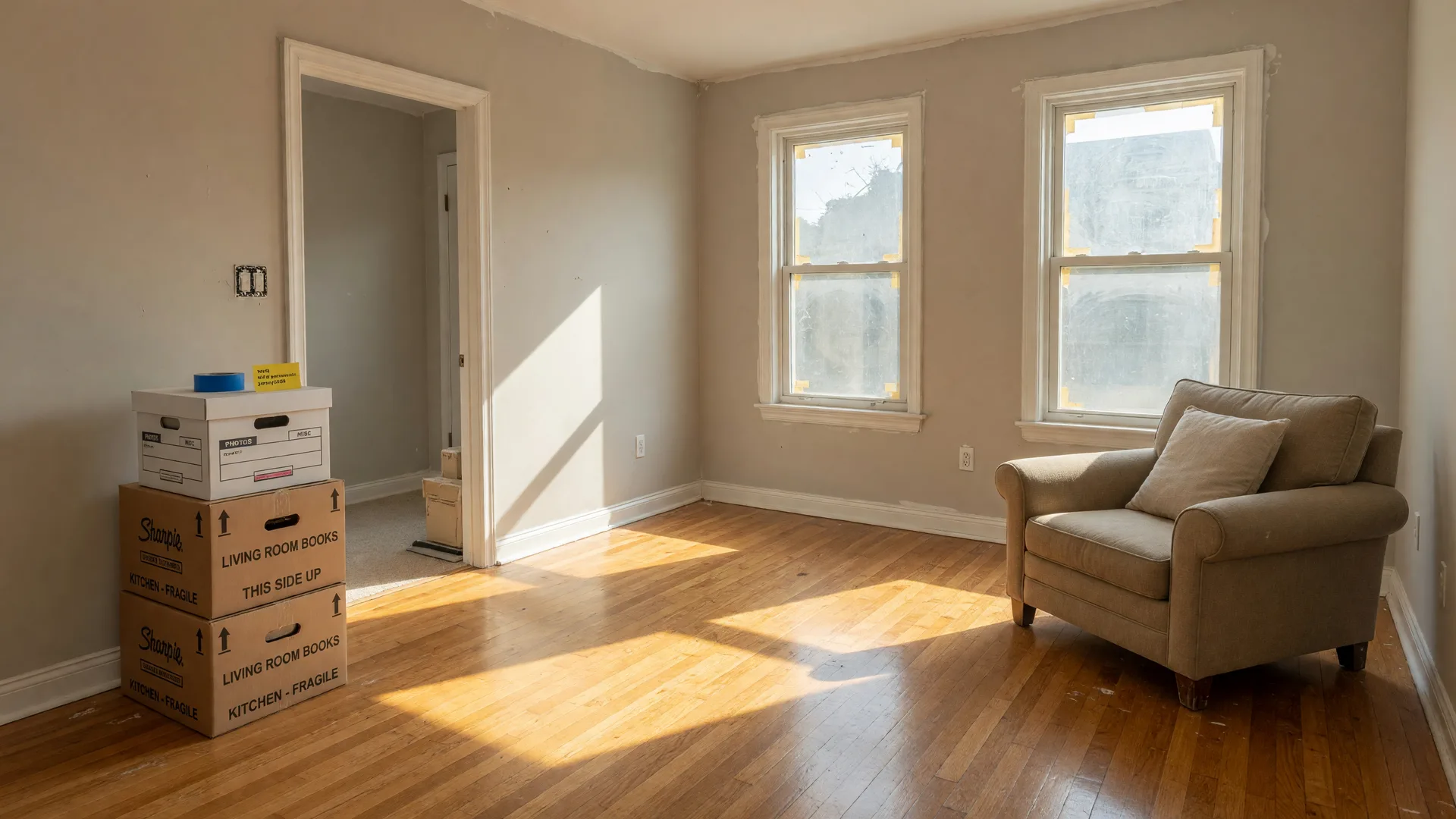
I am not going to pretend this part is easy. You have lived in this house for decades. Every room holds memories. Your children's artwork is in the attic. Your parents' furniture is in the basement. There are boxes you moved into this house 30 years ago and have never opened. The thought of sorting through all of it is paralyzing, so most people put it off. And then the house sits on the market for two months with cluttered rooms and buyers cannot picture themselves living there. The offers come in 10% below what the home is worth. I have seen it happen over and over.
Here is the system that works. Start early. Give yourself three months before you plan to list. Work through the house one room at a time, not all at once. Begin with the rooms your children left behind. Those are the most emotionally charged but also the most straightforward: the things belong to your kids, so call them and give them a deadline to come get what they want. Everything else goes to donation or the dump. Move on to the basement and attic. These are storage rooms, not living spaces, so the emotional attachment is lower. Sort into three piles: keep, donate, and toss. Do not overthink it. If you have not looked at something in two years, you probably do not need it. Finally, tackle the shared living spaces. The kitchen, the living room, the dining room, the primary bedroom. These are the rooms that matter for photographs and showings, so they need to look clean, open, and neutral.
For the items you want to keep but cannot fit in your new home, consider a storage unit. A small 5x10 unit in Passaic County runs about $100 to $150 a month. Use it for seasonal decorations, sentimental items, and things you want to pass down to your children but are not ready to hand over yet. Give yourself a six-month deadline to clear it out. If you have not visited the storage unit in six months, you do not need what is in it. Call me for a list of estate sale companies, donation pickup services, and cleanout crews I trust in the area. This is what I do. I can connect you with people who handle this part for a living, so you do not have to do it alone.
What to Look for in a Downsize: Condos, Townhouses, and Active Adult Communities in North Jersey
The biggest challenge empty nesters face in North Jersey right now is not selling their current home. It is finding the right smaller home to buy. The market is tight for move-in-ready condos and townhouses in Passaic and Bergen County. In Bergen County, townhouses and condos had a median price of $545,000 as of early 2026, up nearly 7% year over year. That tells you demand is strong and inventory is limited. Buyers who wait for the perfect place often find themselves in bidding wars.
Here is where I see empty nesters landing in North Jersey. In Clifton, well-maintained garden-style condos in buildings like the ones near Main Avenue and Route 3 are popular for a reason. They are close to shopping, restaurants, and major highways. Monthly HOA fees of $300 to $500 cover exterior maintenance, snow removal, and trash. In Totowa and Woodland Park, townhouses along the Route 46 corridor offer more space than a condo without the full burden of a single-family home. Newer developments in Totowa have been attracting downsizers with two-bedroom, two-bath floor plans that feel open but manageable. In Paterson and Passaic, the inventory of newer condos is thinner, but there are solid options in well-managed buildings if you know where to look. In Garfield, the proximity to Route 20 and the growing retail corridor makes it a practical choice for empty nesters who want easy access to Bergen County amenities without Bergen County prices. Throughout Passaic County, active adult communities are not as common as they are in Monmouth or Ocean County, but a few newer developments are coming online. If you are willing to look a bit further south or east, the selection opens up significantly. I can point you to specific buildings and developments that are popular with downsizers based on what you are looking for.
The Financial Side: What Happens to Your Equity When You Downsize
This is where downsizing gets exciting. If you bought your Clifton home for $180,000 in 2002 and it is worth $520,000 today, and you owe $80,000 on the mortgage, your equity is roughly $440,000. If you sell and buy a $400,000 condo in cash, you walk away with $40,000 in your pocket plus whatever is left after closing costs. Your monthly housing costs drop to zero mortgage plus an HOA fee of $350 and property taxes of $400 a month. That is $750 total. Compare that to the $1,800 a month you were paying for your mortgage plus taxes before. That is over $1,000 a month back in your pocket starting day one. The flexibility that cash gives you is real. You can use it to travel. You can put it toward healthcare. You can help your grandkids with college. You can invest it and let it grow. Or you can keep it in savings and sleep better knowing you have a cushion. I have worked with empty nesters who downsized and used the freed-up cash to completely change their lifestyle. And every single one of them said the same thing. They wished they had done it sooner.
The Tax Question: Capital Gains on Your Home Sale
Under current federal tax law, if you have lived in your home for at least two of the past five years, you can exclude up to $250,000 of the capital gain from the sale if you are single, or up to $500,000 if you are married filing jointly. Most empty nesters in North Jersey fall well within those limits. If your home has appreciated significantly and you are over those thresholds, you may owe capital gains tax on the difference. But the vast majority of downsizers I work with pay zero capital gains tax because their profit is under the exclusion limit. Talk to a CPA about your specific situation before you list. It costs nothing to ask, and the answer could save you thousands of dollars. New Jersey does not have a separate state-level capital gains tax. Capital gains are treated as regular income for state tax purposes. So you will owe NJ income tax on whatever portion of the gain is taxable at the federal level, but that is only relevant if you exceed the federal exclusion limits.
The Bottom Line
Downsizing is not about losing space. It is about gaining freedom. Freedom from maintenance. Freedom from carrying costs. Freedom from living in a house that was built for a previous version of your life. The process takes planning, honest conversations with yourself and your family, and a willingness to let go of things that no longer serve you. But the result is a home that fits who you are right now, not who you were 25 years ago. If you are sitting in a house in Clifton, Totowa, Woodland Park, Paterson, or anywhere else in Passaic or Bergen County thinking it might be time for a change, call me. We will walk through your numbers, your options, and your timeline. No pressure. No sales pitch. Just honest advice from someone who has helped dozens of North Jersey families make this transition and come out the other side happier.
Ready to Talk About Your Next Chapter?
Whether you are ready to list or just exploring your options, I will give you a straight answer about what your home is worth, what your next home could cost, and how to make the move without the stress. Free consultation, no pressure, completely honest.
North Jersey's AI-Certified Realtor with 15+ years of experience. Specializing in probate sales, short sales, and distressed properties in Passaic and Bergen County.