Cash Flow Projections for North Jersey Multi-Family: The Line-by-Line Model That Keeps Investors Honest

I run the same cash flow model on every multi-family deal I bring to investors in Paterson, Clifton, Passaic, Totowa, Woodland Park, Haledon, and Garfield. And in 15 years, I have seen one mistake cost investors more money than any other. They trust the listing agent's pro forma instead of building their own projection from scratch. That pro forma shows 0% vacancy, no property management fee, no maintenance reserve, and no capital expenditure line. It makes every deal look like a money printer. The real numbers are tighter but more honest. Here is the line-by-line model I use, with a real worked example from Paterson, so you can run your own projections and know whether a deal actually works before you make an offer.
Line One: Gross Scheduled Rent, Not Asking Rent
The first number in every projection is the gross scheduled rent. That is the total rent you would collect if every unit were occupied at full market rent every month of the year. Do not use what the seller is currently collecting, because they may have below-market tenants in place. Do not use what you hope to collect after renovations. Use the market rent for each unit type based on comparable rents in the specific neighborhood. According to current rental data, a two-bedroom unit in Paterson runs roughly $2,100 to $2,700 a month. In Clifton, the same unit runs $2,700 to $3,500. In Passaic, it runs $1,800 to $2,225. If you are buying a three-family in Paterson with three two-bedroom units, underwrite the gross rent at $2,200 per unit, not $2,500. That gives you $6,600 a month or $79,200 a year. You can always be pleasantly surprised if you achieve higher rents. You cannot un-lose money on a deal that only works at the top end of the range.
Line Two: Vacancy and Collection Loss
Every property has vacancy. Even the best-managed buildings in North Jersey have turnover between tenants. The standard underwriting assumption is 5% to 8% of gross rent for multi-family properties. In Paterson and Passaic, where tenant turnover tends to be higher, I underwrite at 8%. In Clifton, where tenant quality and stability are stronger, 5% is reasonable. For our three-family example, at 5% vacancy, subtract $3,960 from the gross rent. That brings you to $75,240 in effective gross income. Notice that is already $3,960 less than the listing pro forma would show. The seller's sheet says income is $79,200. Your model says $75,240. That difference alone changes the deal by nearly a full percentage point on the cap rate.
Line Three: Property Management
If you are self-managing, you can skip this line. But if you are building a portfolio and plan to scale, or if you live outside the immediate area, you need to include a property management fee. Professional management in North Jersey runs 8% to 10% of collected rent. In Paterson, where management intensity is higher due to older buildings and tenant turnover, expect 10%. In Clifton, 8% is more typical. For our three-family with $75,240 in effective gross income, property management at 8% is $6,019 a year. That comes out of your cash flow before you see a dollar. If you are self-managing now, plug this number in anyway. It tells you what the deal looks like when you eventually step back from day-to-day operations. A deal that only works when you self-manage is not a passive investment. It is a job.
Line Four: Property Taxes
New Jersey property taxes are the single highest operating expense in any multi-family projection. In Passaic County, a three-family property assessed at $500,000 to $550,000 will carry annual taxes of roughly $9,500 to $11,000 depending on the town and the assessment. For our example, I am using $10,800 a year. This is not a number you can guess from a county average. Pull the actual tax bill from the town tax collector's office. Look at the current assessed value and the current tax rate. Check whether the assessment was recently changed. A property that just got reassessed could have a materially higher tax bill than the seller's current number. Do not underwrite the seller's tax number. Get the actual bill and verify it against the property's assessed value. Property tax appeals are common in New Jersey, and a successful appeal can improve your NOI, but do not count on it in your underwriting. Underwrite the current tax bill. If you win an appeal later, that is upside.
Line Five: Insurance
A landlord policy on a three-family in Passaic County runs roughly $3,000 to $5,000 a year depending on the property's condition, age of the roof, electrical system, and whether the property is in a flood zone. I use $4,200 for our example. Insurance costs have been rising across North Jersey, particularly for properties with older roofs or outdated electrical. Get a quote from an insurance agent who specializes in rental properties before you make an offer. Do not rely on the seller's current premium. They may have been on a policy for 10 years with a grandfathered rate that you will not qualify for. If the property is in a flood zone, expect an additional $1,000 to $3,000 a year for flood insurance. The Passaic River floodplain affects several communities in the county. Check the FEMA flood maps before you buy.
Line Six: Utilities (The Line Everyone Forgets)
In multi-family properties, the owner typically pays for water and sewer, and sometimes for trash removal and common area electric. In older three-family buildings in Paterson and Passaic, it is common for the owner to also pay for hot water or heating in common areas. For a three-family in Passaic County, water and sewer alone runs $2,400 to $4,000 a year. I use $3,600 for our example. If the owner pays for gas or electric in common areas, add another $600 to $1,200. If the units are separately metered, you are in better shape. If they are not, your utility costs will be significantly higher, and you will have less control over tenant usage. The best way to get this number right is to ask the seller for 12 months of utility bills. If they cannot produce them, underwrite at the high end of the range.
Line Seven: Maintenance and Capital Reserves
This is the line that separates experienced investors from first-timers. Maintenance is the ongoing cost of fixing things that break. Capital reserves are the funds you set aside for major replacements like a roof, boiler, or parking lot. The industry standard is 5% of gross rent for maintenance and 5% for capital reserves, for a total of 10%. For our three-family at $79,200 gross rent, that is $7,920 a year. If the building is older and has deferred maintenance, double the capex reserve to 10%. If the roof is new and the boiler is two years old, you can reduce it. But never underwrite at zero. Something will break, and it will break during the first year you own the building. I have never seen a multi-family property where the first year's maintenance costs were less than 5% of gross rent. Not once in 15 years.
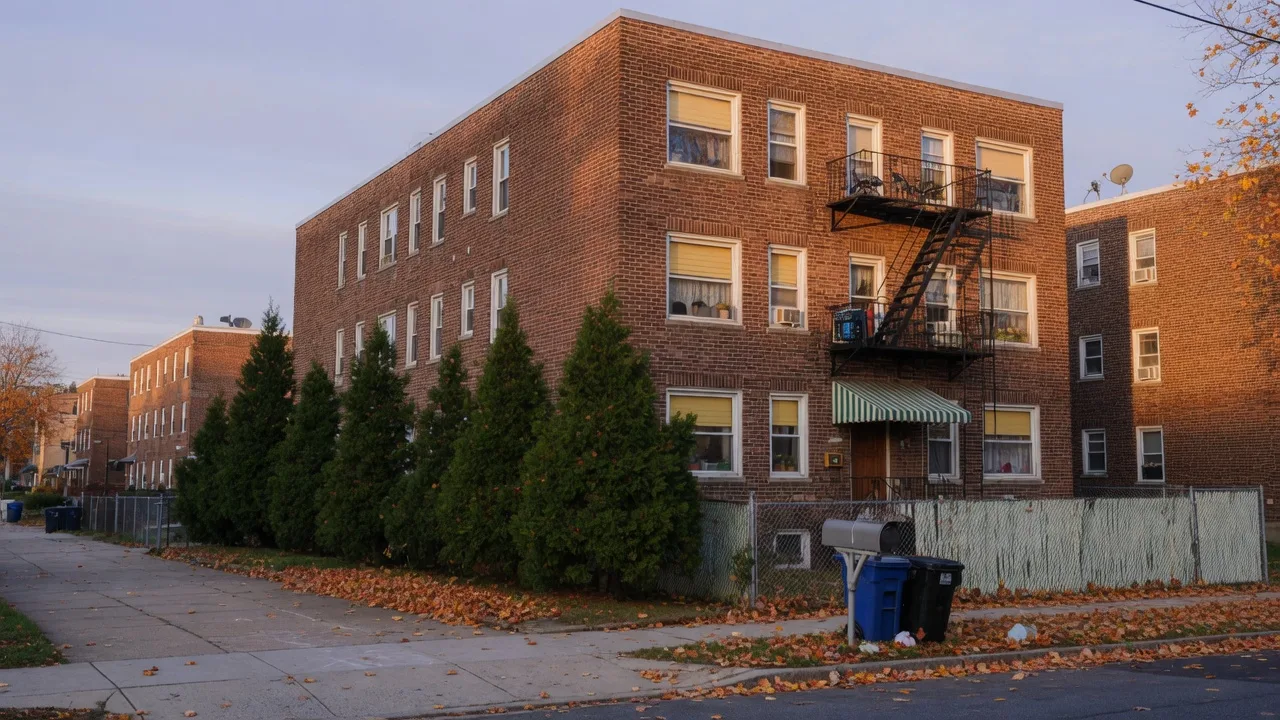
The Worked Example: A Three-Family in Paterson
Here is how the full model looks on a three-family in Paterson at a $525,000 purchase price. Gross scheduled rent: $79,200. Vacancy at 5%: -$3,960. Effective gross income: $75,240. Property management at 8%: -$6,019. Property taxes: -$10,800. Insurance: -$4,200. Water and sewer: -$3,600. Maintenance reserve at 5%: -$3,960. Capital reserve at 5%: -$3,960. Total operating expenses: $32,539. Net operating income: $75,240 minus $32,539 equals $42,701. Cap rate: $42,701 divided by $525,000 equals 8.1%. Now compare that to the seller's pro forma. The seller shows NOI of $60,600, which is gross rent minus only taxes, insurance, and water. That gives a cap rate of 11.5%. The difference is 3.4 percentage points. On a $525,000 property, that is nearly $18,000 a year in phantom income that the seller's pro forma assumes will never be spent on vacancies, management, or maintenance. Do not buy that pro forma. Buy the property based on the honest model.
The Decision Metrics
Once you have the NOI, you can calculate the three metrics that matter. Cap rate tells you the property's return regardless of financing. An 8.1% cap rate in Paterson is solid for a three-family. Cash-on-cash return tells you what you earn on your actual cash invested. With a 20% down payment of $105,000 and a loan of $420,000 at 7.25% for 30 years, annual debt service is roughly $34,380. Cash flow before tax is $42,701 minus $34,380 equals $8,321 a year. Cash-on-cash return is $8,321 divided by $105,000 equals 7.9%. That is a strong return for a buy-and-hold multi-family in North Jersey. The DSCR tells you whether the property can support its own debt. $42,701 divided by $34,380 equals 1.24. Most lenders want a DSCR of at least 1.0. A DSCR of 1.24 qualifies for the best DSCR loan rates, which start around 5.75% for well-qualified borrowers. If you qualify for a DSCR loan at that rate, your cash flow improves significantly because the rate is lower than a conventional investment loan.
How BRRRR and Section 8 Fit Into This Model
The BRRRR strategy works in North Jersey when you buy a property at a discount that accounts for the repairs and the refinance costs. The cash flow model is the same. You just add a renovation budget line and a refinance scenario. The key is that the after-repair value must support the 75% cash-out refinance. If the ARV is $525,000 and you refinance at 75% LTV, you get $393,750 back. If your all-in cost (purchase plus renovation plus carrying costs) is under that number, the BRRRR works. In Paterson, where the spread between distressed purchase prices and after-repair values is the widest in the county, BRRRR deals are the most common value-add strategy. Section 8 fits into the same model with one adjustment. HUD's payment standards in Paterson and Passaic County can be competitive with market rents. The advantage is that the rent comes from HUD, not the tenant, which reduces collection loss. The inspection requirement adds a compliance step, but for a well-maintained property, Section 8 tenants provide reliable, long-term income that improves the stability of your cash flow projection.
The Off-Market Advantage
The best deals rarely hit the MLS. When a multi-family property in Paterson or Clifton goes to the open market, it gets multiple offers and sells near or above asking. The off-market deals are where the pricing gap exists. The seller is motivated, the property needs work, or the situation is complicated. Those are the deals where the underwriting matters most. If you find a three-family off-market at $450,000 instead of $525,000, the model changes. Same NOI of $42,701 on a $450,000 purchase gives you a cap rate of 9.5% and a cash-on-cash return of 12.4% with the same financing. The spread between the listing price and the off-market price is often the difference between a good deal and a great deal. The way to find those deals is through relationships with agents who specialize in your target towns, direct mail to absentee owners, and networking with estate attorneys and probate specialists who know which properties are coming to market before they are listed.
The Bottom Line
A cash flow projection is only as good as the assumptions you put into it. The listing agent's pro forma is not an underwriting document. It is a marketing document. Build your own model. Use actual market rents, not hope. Underwrite vacancy, management, and reserves at realistic levels. Verify the tax bill and the insurance quote before you make an offer. And run the numbers at both the listing price and the price you actually want to pay. The difference between a good deal and a bad deal in North Jersey multi-family is rarely more than a few assumptions. The investors who win are the ones who check every line and know what they are buying before they sign. I have been underwriting, buying, and selling multi-family properties in Paterson, Clifton, Passaic, Totowa, Woodland Park, Haledon, and Garfield for 15 years. If you have a deal you want to run through this model, or if you want to talk about which towns and strategies fit your goals, call me. I will walk through the numbers with you and give you an honest answer about whether the deal works. The goal is not just to close. It is to help you win.
Got a Multi-Family Deal You Want to Evaluate?
I will run the full cash flow model on your target property or target town and give you an honest assessment of the numbers. Free consultation, no pressure, completely straightforward. Bring me the address or the area and I will walk you through what the deal actually looks like.
North Jersey's AI-Certified Realtor with 15+ years of experience. Specializing in probate sales, short sales, and distressed properties in Passaic and Bergen County.